
Last Updated: November 14, 2026
Quick Summary
Custom promotional items for fundraising work best when the item matches the campaign, not the catalog. Most successful campaigns run one hero item, like a shirt or tumbler, plus a low-cost add-on such as a pin, so you capture both buyers and browsers.
- Apparel is the workhorse of fundraising merchandise and the item buyers most often reach for at a table.
- Tote bags are the safest giveaway, but thin handles tear and donors remember the tear.
- Compare net funds raised per campaign, not price per piece, when choosing items.
- Match items to campaign type: premium items for galas, low-cost high-visibility items for festivals.
- Track units ordered, units sold, average order value, and net funds raised for each item.
Table of Contents
- Best Custom Promotional Items for Fundraising: A Quick Comparison
- Custom-Branded Apparel and Event Shirts That Sell Themselves
- Tote Bags, Water Bottles, and Tumblers Donors Keep
- Small Items to Sell for Fundraising: Pins, Magnets, and Pens
- Promotional Items With Logo Cheap Enough to Protect Your Margin
- Custom Promotional Items for Fundraising Wholesale: What to Ask Before You Order
- How to Choose the Right Item for Your Fundraising Goal
- Request a Quote and Lock In Your Fundraising Order
- Frequently Asked Questions
Best Custom Promotional Items for Fundraising: A Quick Comparison
Custom promotional items for fundraising work best when the item matches the campaign, not the catalog. A donor who buys a shirt wears your cause around town; a cheap pen disappears by Tuesday.
The right pick comes down to three things: budget per unit, how you plan to sell or give the item away, and who your supporters are.
How to Read the Comparison Table
Use the table as a starting filter, not a final answer.
| Item | Best For | How It Reaches Supporters | Watch Out For |
|---|---|---|---|
| Custom apparel | Selling at events | Sold at tables or pre-orders | Sizing and minimums |
| Tote bags | Reusable giveaways | Handed out or bundled | Flimsy handles |
| Water bottles and tumblers | Higher-value sales | Sold or used as prizes | Higher unit cost |
| Pins, magnets, pens | Low-cost visibility | Giveaways and impulse buys | Low perceived value |
| Hats and hoodies | Team identity | Sold to supporters | Warmer-weather slow sales |
A quick rule: items people wear or carry daily build awareness, while items people buy at a table build the fund faster. Most successful campaigns run one of each.
Custom-Branded Apparel and Event Shirts That Sell Themselves
Apparel is the workhorse of fundraising merchandise. A well-designed shirt turns your supporters into walking billboards, and it is the item buyers most often reach for at a table.
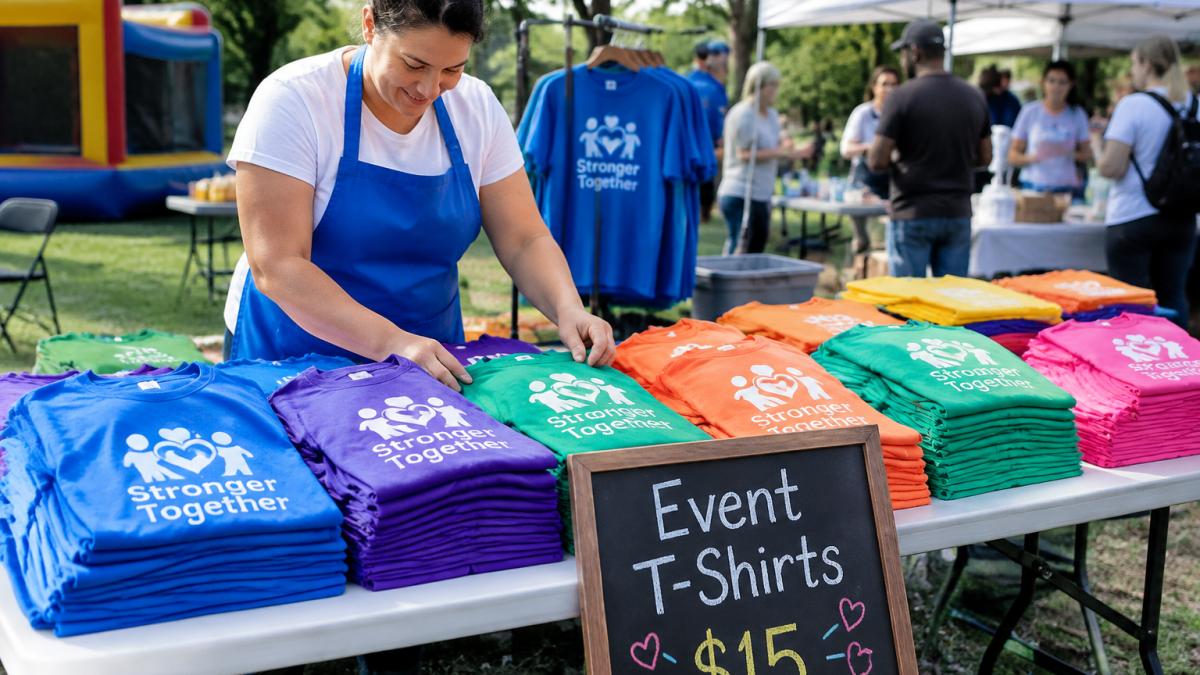
What makes apparel sell is design discipline. A shirt with a clean logo, a strong color, and a cause people believe in moves quickly; a crowded design with six fonts sits in the box.
If you are new to apparel, our guide on how to design custom apparel that looks professional walks through the choices that separate a shirt people wear and a shirt people stuff in a drawer. Our team can also help you prepare print-ready design files.
Shirts, Hoodies, and Hats: What Moves at Events
T-shirts sell best in warm months and at outdoor events. Hoodies carry a higher price and margin but move slower in summer.
Planning team or event shirts? Our step-by-step guide to designing custom team shirts covers sizing, placement, and color choices that sell.
Best for: campaigns with an event date and an audience that will wear the design proudly. Skip if: your supporters are unlikely to wear branded clothing.
Tote Bags, Water Bottles, and Tumblers Donors Keep
Reusable bags and drinkware are the items donors keep and use for years.
Tote bags are the safest giveaway in fundraising: inexpensive at volume, work for every age group, and double as packaging for other items.
Water bottles and tumblers cost more per unit, which makes them better as sale items or donor thank-you gifts than as free handouts.
Best for: awareness campaigns, walkathons, and donor thank-you gifts. Skip if: your budget per item is very tight and you need volume over durability.
Small Items to Sell for Fundraising: Pins, Magnets, and Pens
Small items are the entry point for supporters who will not spend much. Pins, magnets, buttons, and pens cost little, move fast at a table, and give every visitor something to take home.
The trade-off is perceived value. A pen is useful, but nobody feels generous buying one.
- Pins and buttons: cheap, collectible, great for awareness campaigns
- Magnets: stay on the fridge, keep your cause visible for years
- Pens: useful for volunteers and sign-in tables, low perceived value
Best for: awareness campaigns and low-cost giveaways that keep your name visible. Skip if: you need each item to raise meaningful money on its own.
Promotional Items With Logo Cheap Enough to Protect Your Margin
Cheap promotional items with your logo are not about cutting corners. They are about protecting the net proceeds that make the fundraiser worthwhile. Every dollar spent per unit is a dollar that does not reach your cause.
A common mistake is comparing unit cost alone. Compare net funds raised per campaign, not price per piece. Pricing depends on quantity, dates, and delivery, so request a quote from Hatter and Hare Designs for current figures.
A Product-Level Margin Framework
Before you order anything, build a simple margin sheet for each candidate item. Three numbers decide the winner: landed cost per unit, realistic sell-through, and suggested selling price.
- Landed cost per unit. Start with the quoted unit price, then add any setup charges, shipping, and decoration fees spread across the run. Ask for the total delivered cost in writing.
- Minimum order quantity (MOQ). Bulk pricing often starts at a set number of units, so check the quantity thresholds for your order before you commit.
- Realistic sell-through. Estimate how many units you order will actually sell or be given away. Sell-through varies by event, so estimate conservatively based on your audience.
- Suggested selling price. Set the price by what your audience will pay, not by a fixed markup. Check what comparable branded drinkware retails for locally and price below that.
- Net proceeds. Multiply (selling price minus landed cost) by units sold, then subtract any card-processing fees, table fees, or fulfillment costs. That final number is what you compare across items.
Worked Example: Shirt vs. Tumbler vs. Pin
Suppose a school group is choosing between three items for a fall event with an expected 200 attendees.
The shirt usually wins on total net proceeds for an event with a built-in audience, but the pin wins on sell-through and cash risk.
Watch out: a low quote that excludes setup, shipping, or per-color decoration charges can raise your final bill. Always ask for the total delivered cost in writing and divide it by the units you expect to sell, not the units you order.
Protecting Margin Without Cheapening the Item
Best for: campaigns where volume and net proceeds matter more than premium feel. Skip if: the item will be judged as a gift and needs to feel substantial regardless of margin.
Custom Promotional Items for Fundraising Wholesale: What to Ask Before You Order
Wholesale ordering rewards preparation. The groups that get the best pricing and the fewest surprises ask the right questions before they pay a deposit.
Ask these before you order:
- What is the minimum quantity? Bulk pricing usually starts at a set number of units.
- What is included in the quote? Confirm printing, setup, and shipping are all listed.
- What file format do you need? Ask for specs early so artwork does not delay the order.
- What is the production and delivery timeline? Get a date in writing, not a guess.
- What happens if something arrives damaged or wrong? Ask about the replacement policy.
How to Choose the Right Item for Your Fundraising Goal
Match the item to the campaign type and the audience, not to the catalog. A charity walk, a school drive, an online campaign, and a silent auction each attract different supporters with different spending habits.
Use the campaign-type map below as a starting point, then adjust for your specific audience.
Product Recommendations by Campaign Type
Charity walks and 5K events. Participants expect a shirt as part of registration, so apparel is both a giveaway and a identity item.
Silent auctions and galas. The audience is there to spend, so premium items earn their keep.
Community festivals and fairs. Foot traffic is high and attention is short, so low-cost, high-visibility items win.
Online and social campaigns. Without a table, you need items that ship easily and photograph well.
Donor thank-you and major-gift stewardship. The item should feel like a gift, not a giveaway.
Matching the Item to Your Audience
- Price-sensitive audiences (students, families): small items, stickers, pins, wristbands, and low-cost tees.
- Convenience-driven audiences (commuters, gym-goers): tumblers, water bottles, and tote bags that get daily use.
- Identity-driven audiences (team members, volunteers, alumni): apparel, hats, and lanyards that signal belonging.
- Values-driven audiences (sustainability-focused supporters): reusable bags, durable drinkware, and items made from recycled or organic materials; explain the sourcing on the table sign.
- High-capacity donors: premium items and personalized gifts, not volume giveaways.
Fulfillment and Logistics to Plan For
- Lead times. Production and shipping times vary, so confirm the delivery timeline before the event date and build in a buffer.
- Inventory risk. Preorders and bundled packages reduce the chance of leftover stock. If you must over-order to hit a price break, choose an evergreen design you can sell at the next event.
- Distribution at events. Assign one volunteer to the merchandise table with a size chart, a cash box or card reader, and a sign listing prices and bundle deals. A disorganized table loses sales.
- Unsold stock. Plan where leftovers go before the event: an online store, a partner organization, or next season's table. Dead stock is a margin killer.
Measuring What Worked
Track four numbers for each item: units ordered, units sold or given away, average order value, and net funds raised after all costs. Compare them across campaigns to see which item and campaign type actually produce proceeds. Most organizers find that one hero item plus one low-cost add-on outperforms a broad catalog, because it simplifies the table, the signage, and the volunteer training.
Still unsure which item fits your group? You can schedule a design consultation and talk through your campaign type, audience, and budget before you commit to an order.
Request a Quote and Lock In Your Fundraising Order
The best time to plan your fundraising merchandise is before the event date gets close. Ordering early gives you room to fix design issues, confirm sizing, and avoid rush fees.
When you are ready, request a custom quote from Hatter and Hare Designs. Tell us about your project, upload your artwork, and choose your completion date.
Your fundraiser has a goal and a deadline, and the merchandise has to serve both.
Frequently Asked Questions
What are the best promotional items to sell for a fundraiser?
Apparel and drinkware tend to sell best because supporters wear and use them long after the event, which keeps your cause visible. Custom T-shirts, hoodies, insulated tumblers, and tote bags sit at the top of most fundraising product guides. Smaller items like pins, magnets, and pens work better as low-price add-ons or thank-you gifts. Match the item to your audience: school groups do well with shirts and stickers, while community events move totes and tumblers.
What are inexpensive small items to sell for fundraising?
Pins, buttons, magnets, stickers, keychains, and pens are the usual low-cost choices, . Awareness bracelets and custom buttons also fit tight budgets. Keep in mind that a low unit cost does not guarantee a strong margin once design and setup are added. Order in larger quantities to lower the per-item price, and sell small items in bundles so each sale covers your costs.
How do you choose custom products for a nonprofit fundraiser?
Start with your goal and audience, then work backward. A walk-a-thon needs lightweight items like shirts and water bottles; a gala suits higher-value gifts. Set a target margin per unit before you order, confirm the minimum quantity, and ask whether setup or design fees apply. Organizations ordering custom promotional items for fundraising wholesale should also confirm production and delivery timelines so merchandise arrives before the event, not after.
How much should you charge for fundraising merchandise?
Price each item to cover your landed cost plus a clear profit margin, then check that the number feels fair next to similar retail products. Landed cost includes the item, printing, setup fees, and any shipping. The right margin depends on your campaign, so set a target that covers your landed cost and your goals. Test prices with a small presale before committing to a large bulk order.
Where can organizations order custom fundraising products in bulk?
You can order from online promotional catalogs or work with a local print and design shop. If your timeline is tight, ask about delivery and turnaround options before you commit. Request a quote with your quantity, item type, and deadline so the pricing you receive reflects the full order.
